

Between 2014 and 2024, the proportion of Moroccans affected by multidimensional poverty fell from 11.9% to 6.8%, according to the latest figures from the Haut-Commissariat au Plan (HCP). This represents almost 1.5 million people. But what does this figure really measure?
The Multidimensional Poverty Index (MPI) is not solely a measure of income. It takes into account several fundamental dimensions of well-being: access to education, healthcare, decent housing, electricity, drinking water and other basic services. Clearly, a household can have an income considered « decent », but be classified as poor if it is deprived of these essential rights.
This approach allows us to better understand the invisible or silent forms of poverty. And it shows that, despite the progress made, millions of households are struggling.
« We’re no longer just talking about financial poverty, but about multidimensional precarity and vulnerability.There are people living in a rural or urban areas with incomes of 6,000 or 7,000 dirhams, but no access to electricity, healthcare or transport », explains Mohammed Jadri, economic analyst and director of the Observatoire de l’Action Gouvernementale.
Poverty isn’t going away
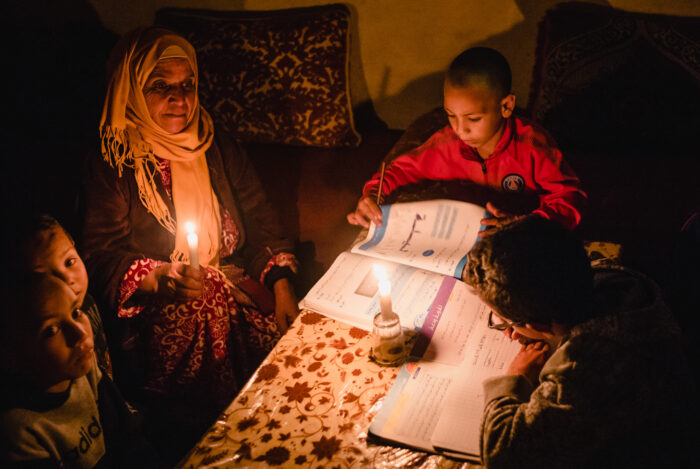
Behind the encouraging figures lies another reality. While the overall indicator is improving, territorial inequalities are lagging behind. In 2024, almost three-quarters of poor Moroccans still lived in rural areas. Although this figure has fallen – from 23.6% to 13.1% in ten years – it is still much higher than in cities, where it has plateaued at 3.0%.
This glaring disparity speaks to the two-tiers in Moroccan society. While urban areas benefit from the country’s economic growth, rural areas suffer from a combination of problems: isolation, drought, under-investment and a job market dominated by insecurity.
And this divide is not just a rural-urban divide. It can be seen at every level of the country. For behind the national averages, a contrasting geography of poverty is emerging, region by region.
In Figuig, Taounate or Chefchaouen, more than one inhabitant in five still lives in deprivation
Some areas, such as Béni Mellal-Khénifra, Drâa-Tafilalet or Marrakech-Safi, have seen spectacular declines – up to 8 points in ten years. Conversely, more urbanized regions such as Casablanca-Settat, where poverty has fallen by just 2.4 points, or Laâyoune-Sakia El Hamra, with a drop limited to 0.9 points, have seen much more modest progress.
At the provincial level, the contrast remains just as stark. Historically poor areas such as Azilal, Chichaoua and Essaouira have seen their situation improve significantly, with a double-digit decline in the poverty rate. Elsewhere, however, poverty remains endemic: in Figuig, Taounate or Chefchaouen, more than one in five inhabitants still lives in poverty.
Stimulating local economies
If we hope to reverse this trend in the long term, real solutions will need to be offered, as opposed to merely throwing around statistics. For Mohamed Jadri, the real answer lies in the state’s ability to target its efforts on the areas left behind, while focusing on the sectors that influence the quality of life.
« We need to invest massively where poverty still persists: in marginalized regions, but also in vital sectors such as water, energy, health, education and infrastructure. As long as we don’t solve these structural problems, we won’t be able to call ourselves developed », he adds.
« It’s not aid that will get people out of poverty in the long term; we need to create valuable economic activity »
Beyond social policies, the central issue remains that of economic integration. And on this point, Driss Effina, professor of economics at the Institut National de Statistique et d’Economie Appliquée (INSEA), insists on the need for a change of approach: « It’s not aid that will get people out of poverty in the long term. We need to create valuable economic activity, and directly invest in neglected areas. »
For him, the state must play a supportive role, not only correcting regional imbalances but also by creating the conditions for equal access to economic opportunities: « One part of the territory is flourishing, connected and integrated into value chains; the other remains stuck in a fragile agricultural model, with no prospects. It’s this divide that needs to be bridged. »
A middle class under pressure
At the heart of this equation resides the middle class. Considered a driver of consumption, a vector of social stability and a lever for growth, it is nevertheless far from homogeneous or solidly anchored. While certain indicators point to an improvement in their living conditions, the reality is more nuanced than might appear.
Driss Effina disputes the idea that the standard of living of the middle class is stagnating. For him, there are several signs of progress: rising housing sales, an explosion in consumer credit, and a steady rise in car sales – from 111,000 units in 2011 to over 161,000 in 2023.« The middle class is buying cars, houses… These are telling indicators. Consumption has increased, particularly in durable goods », he believes.
« After the Covid-19 crisis, some segments of the middle class have fallen into poverty or are vulnerable to the slightest crisis »
In his view, this dynamic reflects a certain economic optimism, supported by easier access to credit, lower interest rates and the widespread availability of banking products. But this positive reading masks another reality: a large part of this middle class is vulnerable, weakened by debt and job instability, particularly in industrial sectors. « There have been major job losses since the Covid-19 crisis, almost 500,000 jobs. Some sections of the middle class have fallen into precarious employment or are at the mercy of the slightest crisis », warns Driss Effina.
Therein lies the paradox: a middle class that’s consuming, but still under pressure, highly exposed to economic shocks and whose standard of living is sometimes based on an unstable equilibrium. According to Bank Al-Maghrib, the household debt ratio has risen by 40% in ten years, a sign of growing dependence on credit to finance both current needs and long-term investments.
And this phenomenon is very unevenly distributed across the country. Cities such as Casablanca, Rabat and Tangiers account for the bulk of real estate lending and purchases of durable goods. In rural and outlying areas, access to housing remains limited, employment prospects are limited, and social mobility is virtually non-existent.
For Driss Effina, the fight against poverty cannot be dissociated from the consolidation of a stable and resilient middle class. For, if the middle class falters, the entire social and economic edifice is weakened. The real challenge, then, is not just to reduce poverty, but to build growth that is inclusive, rooted in the regions and resilient in the face of crises.
Multidimensional poverty rate by region in 2024 :
-
Béni Mellal-Khénifra: 9.8
-
Fès-Meknès: 9.0
-
Marrakech-Safi: 8.5
-
Drâa-Tafilalet: 8.4
-
Tangier-Tétouan-Al Hoceïma: 7.6
-
Oriental: 7.1
-
Casablanca-Settat: 6.5
-
Rabat-Salé-Kénitra: 6.3
-
Souss-Massa: 5.9
-
Guelmim-Oued Noun: 4.2
-
Dakhla-Oued Ed Dahab: 2.5
-
Laâyoune-Sakia El Hamra: 2.4
[/frame]
Written in French by Safae Hadri, edited in English by Theodore Griffin


