

Almost thirteen years ago, in July 2012, Morocco decided to officially sever its diplomatic ties with Syria. The Ministry of Foreign Affairs declared the Syrian ambassador in Rabat « persona non grata, » instructing him to leave the country. This decision came at a time of civil war, when Bashar Al Assad’s regime was bloodily suppressing the first popular uprisings.
Today, this page seems to have been turned once and for all. In a speech read by Nasser Bourita on May 17 at the 34th Summit of the League of Arab States in Baghdad, King Mohammed VI announced the reopening of the Moroccan embassy in Damascus. The sovereign described this gesture as an important « step » that will « open up broader perspectives in the historic relations between our two countries and our two peoples. »
This diplomatic resumption takes place in a new regional political context. The accession of Ahmed Al Charaa to the presidency of Syria, within the framework of a transitional period opened at the end of January, marked a turning point. A former leader of the jihadist group Hayat Tahrir Al Cham, and ex-founder of the Al Nosra Front, Al Charaa was officially congratulated on February 4 by the King of Morocco. In his message, the sovereign reaffirmed a constant line of support « at all times […] for the brotherly Syrian people in realizing their aspirations for freedom, tranquility and stability. »
New foundations
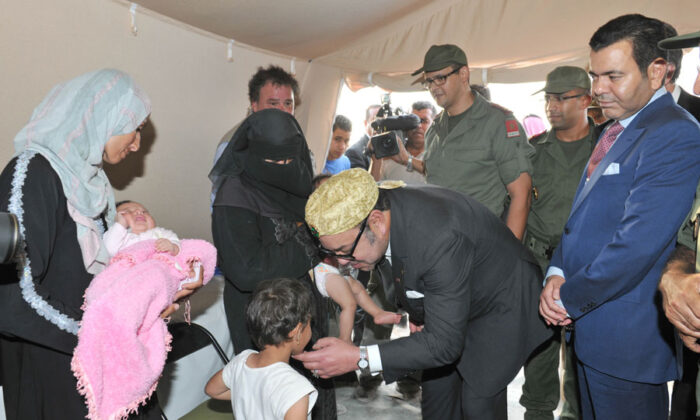
« Morocco has a desire to show the support it has always put forward for the Syrian people. We recall that His Majesty visited the Al-Zatari camp for Syrian refugees in Jordan in 2012. »
This dynamic of normalization reflects a paradigm shift in relations between Rabat and Damascus. « There is the kingdom’s willingness to start on a new footing with the new Syrian regime, knowing that relations have always been very difficult with the Assads, not just Bashar, » stresses Mohamed Badine El Yattioui, professor of strategic studies at the United Arab Emirates Defense College in Abu Dhabi, contacted by TelQuel. « We remember that as early as the late 1970s, there were contacts between the Polisario and Hafez El Assad’s Syria« , recalls Yattioui.
Links between Damascus and the Polisario Front date back to 1978, when Hafez El Assad’s Syria joined a support front initiated by Libyan leader Muammar Gaddafi. Since then, this support – both diplomatic and logistical – has never ceased, even under Bashar Al Assad. Saharawi fighters were even sent to Syria to support government forces during the civil war. And so, obviously, relations have always been very tense between Morocco and Syria », notes Yattioui.
But now, Morocco is clearly showing its willingness to move forward with the new Syrian president. For Rabat, this is not so much a U-turn as a reaffirmation of previously stated principles:« Morocco wants to show the support it has always shown for the Syrian people. In 2012, His Majesty visited the Al-Zatari camp for Syrian refugees in Jordan », recalls Yattioui. This symbolic gesture, made at the height of the Syrian humanitarian crisis, was already part of a humanist approach, dissociating the fate of the Syrian people from that of its regime. Thirteen years on, this same line seems to be guiding the diplomatic resumption: reconnecting with a state in transformation, without denying the values of solidarity that the kingdom claims on the regional scene.
« The Kingdom wants to start again from a bilateral point of view on a good footing, hoping also, because of the reopening of the Syrian embassy in Rabat, for a new dynamic that would eventually allow Syria’s clear recognition of the Moroccan-ness of the Sahara to definitively turn the page on the Assads, » said Yattioui.
For Rabat, normalization with Damascus is not merely symbolic. It is part of a strategic reading, in which the Sahara issue remains central. Any Syrian recognition of Moroccan sovereignty over the territory would represent a major break with the position inherited from the Assad regime, historically aligned with that of Algeria and the Polisario.
International recognition
« The other important element is that Ahmed Charaa has been officially received by several leaders, » continues the researcher. Since coming to power, Ahmed Al Charaa has embarked on an intense diplomatic sequence, marked by meetings with several prominent leaders. Received by Mohammed ben Salmane in Riyadh, by Erdoğan in Ankara, by King Abdullah II in Amman and by Abdel Fattah Al Sissi in Cairo, the new Syrian president has multiplied his gestures of normalization.
« Morocco, as a regional player, cannot remain on the sidelines. There are both bilateral and, of course, regional issues at stake, so that we can cooperate in a whole host of diplomatic, economic and cultural areas, not forgetting security cooperation »
He was also welcomed by the Emir of Qatar, the President of the United Arab Emirates, and paid visits to Bahrain and Lebanon. On the Western side, two highly symbolic meetings took place: with Emmanuel Macron in Paris in early May, then with Donald Trump in Riyadh, marking the first meeting between a Syrian and an American president in a quarter of a century. A busy agenda that confirms the new Syrian regime’s determination to turn the page on isolation, and which is gradually redefining its place on the regional and international chessboard. « Morocco, as a regional player, cannot remain on the sidelines. There are both bilateral and, of course, regional issues at stake, so that we can cooperate in a whole host of diplomatic, economic and cultural fields, not forgetting security cooperation », stresses the professor.
« We know that there are still Daech (ISIS) prisoners in Syria. And obviously, if ever there were Moroccans among them and information could also be useful to the kingdom, good security cooperation would obviously help protect the kingdom’s vital interests, » adds our interlocutor.
The cards reshuffled
The announcement of the reopening of the Moroccan embassy in Damascus is part of a wider drive to reposition the kingdom’s diplomatic presence in the region. It comes almost two years after the reopening of the Moroccan representation in Baghdad, closed since 2005. In January 2023, Nasser Bourita travelled to Iraq to inaugurate this diplomatic mission, alongside his Iraqi counterpart, Fouad Hussein. At the time, this gesture reflected Morocco’s desire to renew ties with Arab capitals that had long been kept at a distance for security or political reasons.
« We’re facing a new dynamic in the Middle East. The fact that we’ve had a regime change in Syria, in which nobody believed anymore, has reshuffled the cards », analyzes Mohamed Badine El Yattioui. In this same evolution, Hezbollah, a pillar of the Assad regime, has been greatly weakened in Lebanon, as in Syria. Moreover, Iran’s influence in these two countries is in sharp decline.
« These factors mean that Morocco is keen to influence the debate, especially as the situation in Gaza continues and worsens daily for the Palestinian population. The kingdom’s desire to position itself as a possible mediator between the various Israeli and Palestinian parties is clear », he continues.
In a Maghreb context marked by tensions and persistent complexity, Morocco wants to assert its role as a central player in the Arab world, capable of mediating in regional conflicts. This strategic repositioning, the fruit of a new political and security reality, is not only useful, but necessary. According to Yattioui, it will enable Morocco to have a greater say in the Middle East’s equilibrium, and to assert its place as a key player in a region undergoing radical change.
Written in French by Ghita Ismaili; edited in English by AngloMedia Group.


